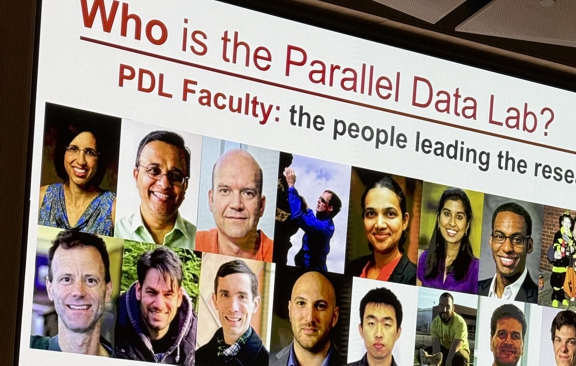
PDL photos from Retreat - March 2026

This is our first directors’ greeting after 25 years of Greg Ganger’s PDL leadership, and we’re both excited and honored to step into those shoes. Thank you for leading such a vibrant and amazing community, Greg!
 It has been another great year for PDL, with lots of changes. Our 31st Retreat moved to the spring for the first time, taking place on the CMU campus March 2-4, 2026, and it was great to see many of you there – as always, materials are available online. Several new and existing faculty joined the PDL team. Our newsletter has now moved online, so you can easily navigate it from your devices. And that was our final retreat – we are looking forward to seeing you all at the PDL Summit this spring!
But, many important things remained the same – PDL papers appeared at OSDI, EuroSys, ASPLOS, VLDB, MICRO, SC, and many other prestigious venues. PDL students had fantastic internships at PDL member companies (which led to several of those papers). PDL researchers also brought home a VLDB Best Paper Honorable Mention, a EuroSys Test of Time Award and several major individual awards. Specifics can be found throughout the newsletter, but let us highlight a few things.
Long-running projects from the past two letters turned into papers this year. The biggest is Declarative IO, which was presented at OSDI’26. Across six hyperscalers, 45-70% of after-cache disk IO is spent on maintenance work like scrubbing, compaction and garbage collection, and caching handles it poorly. Our DINGO prototype lets those tasks declare their IO needs, so an IO planner can merge and reschedule them. It saves 26-51% of maintenance IO for realistic task mixes, enough to deploy 1.7x larger HDDs. In a companion EuroSys’26 paper, we built a TCO model and cluster optimizer from 43 production datasets at two hyperscalers. It shows when the highest-density SSDs pay off at exascale: for heavy AI/ML clusters, but only when paired with high-density HDDs. We’re not missing in cache, either: Our VLDB’26 paper on lazy promotion in cache eviction won a Best Paper Honorable Mention. It reduces promotions by 20-60% at the same or lower miss ratio.
At the retreat, we announced our focal area of helping achieve the next 1000x scaling, particularly for AI/ML systems, by improving efficiency and utilization. This year we’ve dived deeply into serving: AdaServe (EuroSys’26) uses speculation trees built per request to serve LLM requests with different latency targets. It cuts SLO violations by up to 4.3x and improves goodput by up to 1.9x. FlexLLM (NSDI'26) runs inference and fine-tuning together on shared GPUs, interleaving their work token by token. It improves fine-tuning throughput by 1.9-6.8x while still meeting inference SLOs.
Memory and hardware research continues across the stack, much of it with PDL consortium members. Equilibria brings fair, per-container CXL memory tiering to Linux. Evaluated in a hyperscaler’s fleet, it beats Linux’s current tiering approach by reducing its latency by 52%, and its patches have been released to the Linux community. Learning to Walk (MICRO’25) replaces radix page tables with a learned index, cutting address translation overhead by 44% on average. SEVI (ASPLOS’26, hosted right here in Pittsburgh!) studied silent data corruption in vector instructions across more than 14 billion CPU seconds of testing at hyperscale. Its detector catches 88-100% of affected machines at 1.35% overhead. On processing-in-memory, PIM-zd-tree (PPoPP’26) reaches up to 99x the throughput of shared-memory baselines. A new PIM scheduler (SPAA’26) gives up to 1.8x speedups on a 2,048-module UPMEM machine.
Our collaboration with Los Alamos National Laboratory continues strong. ORCA, which was presented at SC’26 this month, provides always-on observability for large parallel simulations. On an AMR code at 4,096 ranks, it costs about 2% overhead, compared with 56-81% for tracing tools. Controlled by an AI agent, it also localized in 27 minutes an anomaly that had taken months to diagnose by hand (CLUSTER’25). Together with LANL, we have also built testbeds to advance open-standard pNFS as a high-performance storage option for AI, which are currently humming away and we are hoping to have results we can share publicly soon.
 Recognition this year spanned work old and new! The GeePS paper from 2016 won the EuroSys’26 Test of Time Award, a nice reminder that PDL’s early ML-systems work still matters a decade later. Phil Gibbons received the SPAA Parallel Computing Award for work that bridges the theory and practice of parallel algorithms. Akshitha Sriraman was named the CRA’s 2026 Anita Borg Early Career Award recipient. Justine Sherry received the 2026 SIGCOMM Rising Star Award. PDL alum Mohammad Bakhshalipour picked up a third award for his dissertation, Steven Dong took first place in the SIGCOMM Student Research Competition, and two CMU systems dissertations (Hugo Sadok, advised by Justine Shery, and Anup Agarwal, advised by Srini Seshan) swept CMU’s nominations for the ACM doctoral dissertation award.
PDL faculty are also taking on bigger roles at CMU. Jignesh Patel has been tapped to become the founding dean and vice president of CMU Miami, and Phil Gibbons has stepped in as interim head of the Computer Science Department. We are also delighted to welcome Theophilus Benson and Justine Sherry, who join PDL this year as faculty members.
This year, six PDL students defended their PhD dissertations and seven more proposed theirs. Our graduates are off to industry labs, faculty positions and startups they co-founded, and we are especially glad to see several current students and recent alumni join PDL Consortium members like Jane Street, Bloomberg, Salesforce, Uber, Google, and Microsoft. If you have openings for both internship and full-time positions, check out our recently published resume books.
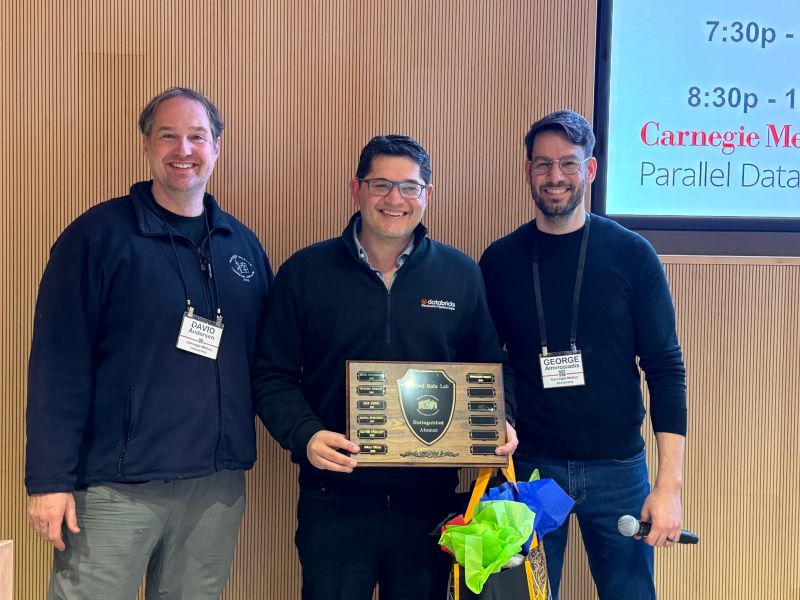
Last but not least, we had the honor to induct another PDL Alum, Dr. Ippokratis Pandis, to our group of Distinguished PDL Alumni at the last PDL Retreat where he delivered a humble-yet-inspiring talk – we are proud that he is a member of the PDL community!
Almost every result listed above depended on PDL consortium members. You gave us production traces and telemetry, access to real fleets and devices, hosted students as interns, and peppered us with hard questions. We are very glad to welcome Uber to the PDL Consortium; our Moirai work (SOSP’25) with Uber’s data platform team showed how productive partnerships can be. Many other PDL projects are also producing cool results, too many to cover while keeping this note brief. The rest of this newsletter and the PDL website have more details. We thank every member company for making this research possible.
Last but not least: please save the dates – our annual gathering gets a new name! The inaugural PDL Summit, our 32nd annual event, will be on the CMU campus March 8-10, 2027. We hope to see you there.
We are always overwhelmed by what PDL students, staff and faculty accomplish, and it is a unique privilege to work with them. As always, their work points to great things to come.
George Amvrosiadis and Dave Andersen,
PDL Co-Directors

PDL photos from Retreat - March 2026